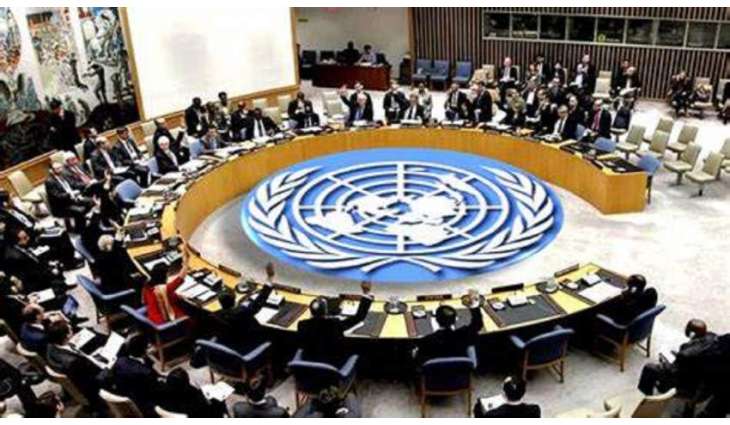
Seventy-five years since its formation and nine months into the global COVID-19 pandemic, the United Nations and its Security Council are no longer reflecting the new balance of power and are failing to properly represent the global community, but a much-needed reform of the organization's key decision-making body will likely be impeded by opposition from both current permanent members and regional rivals of permanent seat bidders, analysts told Sputnik
MOSCOW (Pakistan Point News / Sputnik - 23rd September, 2020) Seventy-five years since its formation and nine months into the global COVID-19 pandemic, the United Nations and its Security Council are no longer reflecting the new balance of power and are failing to properly represent the global community, but a much-needed reform of the organization's key decision-making body will likely be impeded by opposition from both current permanent members and regional rivals of permanent seat bidders, analysts told Sputnik.
Ahead of and during the high-level week of the 75th session of the UN General Assembly, which kicked off in New York on Monday, leaders of several major world and regional powers have spoken about the urgent need to reform the United Nations to better equip the organization for new threats and challenges.
Proposals include adding new permanent members, and granting them veto powers or scrapping them altogether. To date, only the victors of World War II � China, France, Russia, the United Kingdom and the United States � hold permanent seats in the UNSC and have the power of veto.
"The shortcomings of the UN start and end with the Security Council which is the only authoritative decision-making body and whose permanent members (USA, UK, France, Russia, PRC) have a veto. The present UNSC clearly lacks legitimacy. It does not represent the global community, nor does it reflect the present balance of global power," Alan Cafruny, Henry Platt Bristol Professor of International Affairs at the Hamilton College, told Sputnik.
Another problem is the fact that now, unlike in the past, major world powers themselves tend to ignore the United Nations in their decision-making process, D. Roderick Kiewiet, professor of political science at the California Institute of Technology, told Sputnik.
"I think the first thing to say is that it has been a long time since any of the major powers were much concerned about getting a UN Security Council Resolution or similar statement by the UN before doing whatever it is they wanted to do in foreign affairs ... It is true that the US obtained such resolutions in 1990 and 2002 before attacking Iraq, but I'm pretty sure we would have done that anyway without such resolutions," Kiewiet told Sputnik.
Thomas Whalen, an associate professor in the social science department at the Boston University, in turn, noted that the UNSC in its current composition was designed for a completely different era in world history.
"Why, for example, is Britain or France on it? I don't think anyone would confuse them with global superpowers like China and the US. The current makeup does not reflect current reality or global power arrangements," Whalen told Sputnik.
Wyn Grant, professor of international politics at Warwick University, similarly noted that the current permanent members of the Security Council did not reflect all the geopolitical changes that had taken place since the organization's establishment 75 years ago.
"There is a strong case for increasing the permanent membership to give a better geographical spread and in particular to represent emerging countries. Perhaps unavoidably members tend to take rather rigid positions, but a wider membership could bring new perspectives," Grant told Sputnik.
According to researchers, new permanent members may include India, Japan, Germany and Brazil, who have even formed the Group of Four, or G4, bloc to back each other's membership bids. Alternatively, decisions on adding new permanent seats could be made from the perspective of regional representation. For example, there is "an obvious need" for the representation of Africa in the Security Council, Cafruny noted.
"However, expansion of the permanent membership would be meaningless unless the new members were granted veto power," the researcher stressed.
But all analysts agreed that such a reform would inevitably be opposed by the existing permanent members, referred to as the Big Five or P5.
"The Big Five are bound to resist any such change as they will fear that their seats might be in jeopardy or at least their influence would be diluted," Grant said.
Whalen similarly expressed expectations of "fierce opposition" from the P5 nations, saying that "power does not give way easily."
Kiewiet, however, suggested that permanent members could be divided on the issue of adding new members to the council.
"Would China be OK with adding Japan and/or India? I seriously doubt it," he said.
The researcher noted, however, that Russia seemed to be "curiously flexible and non-confrontational in the UN".
"For that reason, I could foresee Russia being supportive of adding these new countries � say in return for Russia rejoining the G7 and make it the G8 again � something that I think should happen in any case regardless of what's going on at the UN," Kiewiet stressed.
Cafruny of the Hamilton College asserted that the reform could be opposed not only by the Big Five, but regional rivals of the contenders for permanent membership as well.
"Changes would also be unlikely to receive the endorsement of the General Assembly. Existing members of the UNSC are unwilling to relinquish their own veto power or extend it to more countries. The bids of G-4 countries for permanent membership would certainly be opposed by regional rivals. Pakistan is unlikely to endorse India's bid for membership," Cafruny said.
The researcher also recalled that France has historically rejected a permanent seat on the UNSC for Germany � or the European Union.