Egypt will not contribute to the separation of Libya and understands its territorial integrity, Ahmed Huma, the second deputy speaker of the Tobruk-based parliament, told Sputnik in an interview, commenting on Cairo's announcement about readiness to intervene in the neighboring conflict
BENGHAZI (Pakistan Point News / Sputnik - 29th June, 2020) Egypt will not contribute to the separation of Libya and understands its territorial integrity, Ahmed Huma, the second deputy speaker of the Tobruk-based parliament, told Sputnik in an interview, commenting on Cairo's announcement about readiness to intervene in the neighboring conflict.
Earlier this month, Egyptian President Abdel Fattah Sisi announced that Cairo was ready to help the eastern administration, saying that a possible capture of the key city of Sirte by the forces of the UN-backed Government of National Accord, located 560 miles from the border with Egypt and currently controlled by the parliament-allied Libyan National Army (LNA), would be the "red line." The LNA welcomed Cairo's announcement and introduced a no-fly zone over Sirte on Sunday. Following this step, the eastern parliament's speaker, Aguila Saleh, said that it would officially ask Egypt to intervene in Libya if the GNA troops seized Sirte and LNA's Al Jufra Airbase in the country's center and move further to the east.
"First of all, Libya is made up of three main regions: Cyrenaica, Tripolitania and Fezzan. If we talk about the Government of National Accord's request or invitation for the Turkish government to intervene in Libya's internal affairs, they have an agreement on the region of Tripolitania, of which Sirte is an integral part. However, Jufra has not been and will not be part of the Tripolitania region, as it belongs to Fezzan. When President Sisi was talking about Sirte and Jufra, it was an indicator of his understanding that Libya was united and would not accept the division in any way, and Egypt would not contribute to it," Huma said.
There is evidence of the Turkish military presence in Libya, including its arms supplies to the forces of the western-based government, warships in the Libyan territorial waters and aircraft "hovering in the latter's airspace," the deputy speaker added, referring to Turkish President Recep Tayyip Erdogan when he said "we liberated Tarhuna and the Tripoli airport."
"If we assume that Egypt has spoken only about Sirte and not mentioned Jufra, it would have been evidence of silence on the issue of the country's division, and that is of the utmost importance. If the city of Sirte had already been penetrated, they [the Government of National Accord's forces and its allies] would have headed directly to the 'oil crescent'. This thing will not go unheeded and lead to a civil war. We do not absolutely accept it, and there is the essence of Egypt's role [in Libya] to stop this arrogance," the deputy speaker said, adding that Turkey was trying "once again" to help those countries "responsible for a gross encroachment" on Libya's affairs.
The "oil crescent" region includes foreign petroleum companies and stretches along the country's coast from the port city of Tobruk, where the LNA-backed eastern Libyan parliament is based, to the oil depot of As Sidr.
"In regard to Egypt as a neighboring and friendly country to Libya, there were long-standing alliances throughout history initiated by both Egypt and Libya. Moreover, Libya is a strategic depth for Egypt, considering that Egypt plays a major role, whether in the Arab world, in Africa, or even at the international level," Huma noted.
There are also some experts talking about the Turkish intervention, as well as the alleged Russian and Egyptian presence in the North African country, the deputy speaker noted. According to them, they did not "see any Egyptian forces or weapons on Libyan soil nor any Russian government troops, while there are a number of Turkish soldiers," the Libyan official added.
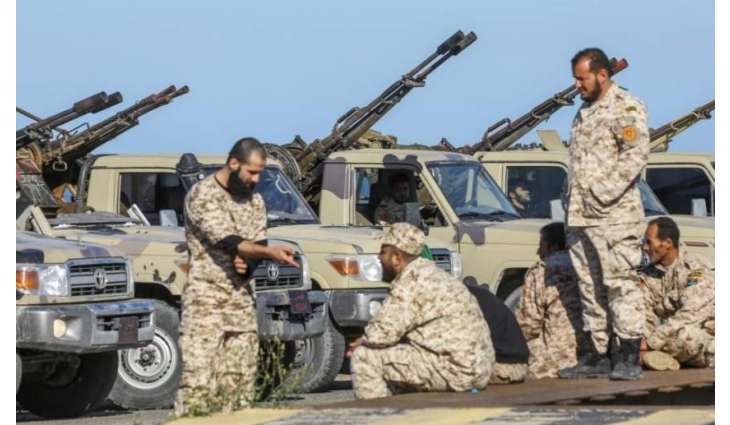
Libya has been divided for years between the two rival governments seeking to establish control over the entire country. Commander Khalifa Haftar's army, the LNA, has been laying siege to the capital of Tripoli since the spring of 2019 in a bid to capture the seat of the Government of National Accord (GNA).
In recent weeks, troops affiliated with the GNA have made major military gains against Haftar's army. The western-based government backed by Turkey and Qatar has said that it wants to seize the strategic city of Sirte, currently under the control of Haftar's forces.