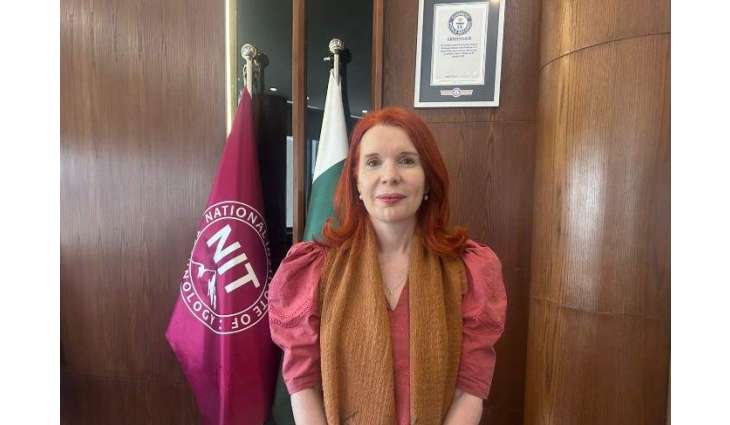
Dr Victoria C Fontan, an international expert in higher education and peace studies, shares her views at National Institute of Technology Lahore
LAHORE: (UrduPoint/Pakistan Point News-April 20th, 2026) Education can play a central role in building peace, reducing conflict and creating opportunities, a leading global scholar said during her recent visit to Lahore.
Dr Victoria C Fontan, an international expert in higher education and peace studies, shared her views at the National Institute of Technology Lahore. She spoke about education, conflict zones, women’s learning and the future of universities in Pakistan.
Dr Victoria has worked in some of the world’s most difficult regions, including Somalia, Sudan and Afghanistan. She has spent more than 20 years in higher education leadership and has led major academic institutions.
She said her journey began with a simple belief. “Education is the main driver for peace and sustainability in any country,” she said.
In the 1990s, she explained, the focus was mainly on development. Many believed that economic growth alone could solve social problems. But over time, this thinking changed.
“We realised that development without social awareness and responsibility is not enough,” she said. “Now the focus is on peace, sustainability and conscious development.”
Dr Victoria said her own background shaped her thinking. She comes from France, a country that once had deep conflicts with Germany. Over time, both countries built strong economic ties. This helped create lasting peace in Europe.
“This showed me that cooperation and education can reduce conflict,” she said.
Her work later took her to conflict-hit regions. She served as provost at the American University of Afghanistan during a difficult period. Even after leaving the role, she continues to support education efforts in Afghanistan.
She said Afghanistan remains deeply divided after decades of conflict. When she arrived there in 2019, violence was widespread and civilians were suffering.
“One major divide was between cities and rural areas,” she said. “People were living very different realities.”
After 2021, the situation changed again with the return of Taliban rule. She said women and minorities are now the most affected groups.
Despite this, she believes there is still space for change. “Not all parts of the system are the same. Some are open to dialogue,” she said.
To support women’s education, Dr Victoria helped create an international alliance. The aim is to provide learning opportunities while respecting local conditions.
“We do not want confrontation. We want practical solutions,” she said.
According to her, the alliance now reaches nearly 900,000 learners through around 130 organisations. These include both online and in-person programmes. Many women study from home due to restrictions.
She said women are learning skills such as software development and cybersecurity. This allows them to work from home and support their families.
“Women still want to learn. If students are willing, educators must find ways,” she said.
Local communities are playing a major role. Neighbourhood groups and former students are helping others continue their education. International partners are also involved, including universities and organisations like UNESCO and UNHCR.
“This collective effort is making a difference,” she said.
Dr Victoria also explained the concept of peace education. She said it is not limited to teaching conflict resolution.
“It is about creating a safe space where learners can think and find solutions,” she said.
She added that peace education includes collaboration, innovation and strong governance. Transparency, accountability and respect for rules are all part of this system.
“It is about helping people become the best version of themselves,” she said.
During her visit, she also spoke about Pakistan’s growing role in the world. She said the country is undergoing rapid change and is becoming an important economic and geopolitical player.
She praised institutions like NIT Lahore for focusing on innovation and entrepreneurship. “It is not just about knowledge. It is about building an ecosystem,” she said.
According to her, modern universities must connect education with industry and society. They must prepare students for real-life challenges, not just exams.
She also highlighted the need for global standards adapted to local needs. “This balance is very important,” she said.
Dr Victoria said Pakistan has strong potential in education. She noted that academic discussions in universities show critical thinking and freedom of ideas.
However, she pointed out that different disciplines often work in isolation. “Departments do not collaborate enough. This is a lost opportunity,” she said.
She added that universities must bring different fields together and focus on solving real-world problems.
Her overall message was clear. Education is not just about degrees. It is a tool for peace, development and social change.
“Education can shape societies. It can reduce conflict and build a better future,” she said.