MOSCOW/STARITSA (Pakistan Point News / Sputnik - 06th October, 2020) Denis Chernyshenko - A Sputnik correspondent has visited the small town of Staritsa on the Volga River, which is the birthplace of Job, the first Patriarch of Moscow and All Russia.
Staritsa is located in the Tver Region, some 175 kilometers (108 miles) northwest of Moscow. Now it is a small town with a population of about 7,500 people, but in the 16th century, the settlement witnessed drastic events that affected the whole Russian history.
There are many ways to reach Staritsa from Moscow by car: via the M-10 Rossiya, M-11 Neva, M-9 Baltic highways, or via the town of Lotoshino. We have chosen the first option.
After reaching Tver, you should turn to the left to go to Staritsa via the R-132 roadway, which is connecting the two biggest cities of the region Tver itself and Rzhev, famous for the bloody battle during World War II.
One of the most interesting places to visit on the R-132 roadway is the small village of Ivanishchi that hosts the Church of the Dormition of the Mother of God built in the 16th century.
This was the main cathedral of the Dormition Monastery that was dissolved in 1764. This place was also used for filming some episodes of the famous Soviet movie "Naval Cadets, Charge!"
The town was founded in 1297 by legendary Prince Michael of Tver, who was canonized over his heroic struggle with both the Golden Horde and the Principality of Moscow.
Staritsa became a part of the Grand Duchy of Moscow as a result of the fall of the Tver Principality in 1485. However, at the beginning of the 16th century, the territory around the town became a separate principality, one of the latest semi-independent Russian principalities.
Since 1519, it had been ruled by Andrey Ivanovich, the youngest son of Ivan III The Great of Moscow and Sophia Palaiologina of Byzantium, as well as the brother of Grand Duke of Moscow Vasily III.
In 1533, Vasily III died and, as his son Ivan (Ivan IV The Terrible in the future) was too small, the throne was seized by Vasily's widow, Elena Glinskaya, and her favorite, Ivan Ovchina-Telepnev-Obolensky. The opposition, disappointed with the regent rule of Glinskaya, consolidated around Andrey of Staritsa. To settle the crisis, Ovchina-Telepnev-Obolensky invited him to negotiate with Glinskaya in Moscow, but when Andrey arrived in the capital, he was imprisoned and soon died in jail.
After that, the Principality of Staritsa was headed by Andrey's son, Vladimir. He was a significant public and military official during the rule of Ivan The Terrible. In 1569, Vladimir of Staritsa was executed over the treason suspicions.
Several years later, the Principality of Staritsa was liquidated, which marked the final consolidation of Russian territories around Moscow. In 1579-1581, Ivan The Terrible lived in Staritsa during the offensive of Polish King Stephen Bathory on Russia.
In 1525, Job of Moscow was born in Staritsa and in 1569, he headed the Dormition Monastery there. After that, he headed several monasteries in Moscow and in 1589, he became the Metropolitan of Moscow. Three years later, Ecumenical Patriarch of Constantinople Jeremias II visited Moscow and enthroned Job as the first Patriarch of Moscow and All Russia.
Job was toppled in 1605 after he had refused to recognize pretender False Dmitry I as the tsar of Russia.
In the following centuries, Staritsa turned into a small provincial town. In the 18-19th centuries, the town was a center of limestone production. The town was severely damaged in 1941-1942 during the World War II fighting.
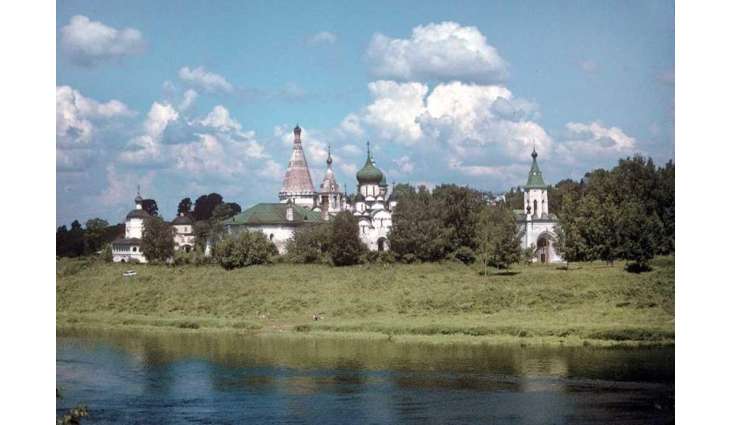
The main sight of Staritsa is undoubtedly the Dormition Monastery of Job of Moscow. The white-stone monastery built on the picturesque bank of the Volga River was closed in 1919 by the Soviet authorities and reopened only in 1997. The renovation was completed in 2013, and now it is one of the most beautiful monasteries of the Tver Region.
The historical center of the town with Boris and Gleb Monastery, the impressing Church of St. Paraskeva and limestone quarries are located on the opposite bank of the Volga. Unfortunately, most sights on this bank of the river are in decay but small renovation work is here underway.
The banks of the river are connected with the mighty arc bridge, which can be considered as a sight itself.
Like many other interesting places in Russia, Staritsa has a huge tourist potential that has not been fully used to attract visitors. However, the progress reached in the recent two decades leaves hope that Staritsa will be able to turn into a new tourist mecca of Central Russia.