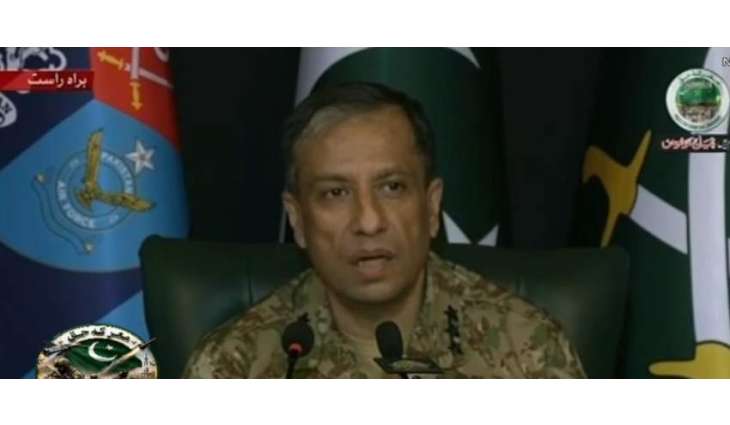
Lieutenant General Ahmed Sharif Chaudhry says Marka-e-Haq completed one year and remained an important reference point in recent regional developments this year.
ISLAMABAD: (UrduPoint/Pakistan Point News-May 7th, 2026) Director General Inter-Services Public Relations (ISPR) Lieutenant General Ahmed Sharif Chaudhry on Thursday said that India’s propaganda and narrative against Pakistan has now completely collapsed.
Addressing a press conference marking the first anniversary of Marka-e-Haq, he said that India had attempted for years to establish a perception that Pakistan was involved in terrorism-related activities, but those efforts had now been “buried by facts and ground realities.”
The DG ISPR said that Marka-e-Haq completed one year and remained an important reference point in recent regional developments this year.
Referring to the Pahalgam incident, he questioned the credibility of the investigation process, asking how a First Information Report (FIR) could be registered within 15 minutes of the incident. He termed it an example of what he called an orchestrated narrative against Pakistan.
Lt Gen Chaudhry said that despite repeated accusations, no credible evidence had been presented by India to support allegations of Pakistan’s involvement in the incident.
He added that even within India, sections of the media and the public had raised questions over the government’s claims, particularly regarding the absence of verifiable proof.
“strategic consequences” of Marka-e-Haq
DG ISPR Lt General Ahmed Sharif Chaudhry also said that Marka-e-Haq produced multiple strategic outcomes that reshaped regional perceptions, strengthened Pakistan’s deterrence posture, and exposed what he called “misleading narratives” against the country.
The DG said the first major outcome was the collapse of India’s longstanding narrative portraying Pakistan as a source of terrorism. He stated that the international community now recognizes Pakistan as a victim of terrorism rather than its sponsor, as previously alleged by New Delhi.
Referring to the Pahalgam incident, he said Pakistan had raised several questions which remain unanswered, including concerns over the rapid registration of an FIR within minutes. He added that no credible evidence had been presented to support allegations against Pakistan.
He said the second outcome of Marka-e-Haq was Pakistan’s emergence as a stabilising force in the region. According to him, the situation demonstrated that Pakistan exercised restraint and maturity during escalation, while highlighting responsible conduct by its armed forces.
Lt Gen Chaudhry said the third consequence was the increasing politicisation of military institutions in India and the militarisation of political discourse. He criticised statements by Indian military officials after the conflict, terming them contradictory and damaging to professional credibility.
He further stated that Indian political leadership was increasingly adopting aggressive rhetoric, warning that the blending of politics and military affairs posed risks to regional stability.
The fourth consequence, he said, was global recognition of what Pakistan describes as India’s tendency to externalise internal challenges while projecting blame outward. He referred to issues such as minority treatment and the Kashmir dispute, stating that these were political matters requiring internal resolution rather than external attribution.
He reiterated that Kashmir is an internationally recognised dispute and not an internal matter of India, adding that attempts at demographic changes there were unacceptable under international norms.
The DG ISPR said the fifth outcome was the exposure of Indian media narratives and information operations during the conflict. He said misinformation campaigns were countered and stressed that in the modern information environment, “truth remains the most powerful tool.”
He added that restrictions placed on media and digital platforms during the situation reflected an attempt to control narratives rather than address facts.
The sixth strategic consequence, he said, was the transformation of modern warfare, which now extends beyond conventional battlefields to cyber, cognitive, air, sea, and space domains. He said Pakistan’s armed forces demonstrated preparedness across all such domains during Marka-e-Haq.
Lt Gen Chaudhry said the seventh outcome was the demonstration of national resilience and confidence, adding that the event strengthened belief in Pakistan’s ability to face complex challenges.
The eighth consequence, he said, was the reinforcement of deterrence between two nuclear-armed states, stressing that war between such countries is neither feasible nor rational. He cautioned against any miscalculation regarding conflict in the region.
He said the ninth outcome was Pakistan’s enhanced recognition as a responsible and geopolitically significant middle power, with improved diplomatic and military credibility on the global stage.
The DG ISPR said the most important outcome was what he described as the “unbreakable unity” between the people, government, and armed forces, which he termed the Bunyan-um-Marsoos effect.