In an era where operational disruptions can wipe out billions in shareholder value and where sustainability is becoming central to business license-to-operate, Environmental, Health & Safety (EHS) has emerged as one of the most critical levers of modern corporate strategy
LAHORE: (UrduPoint/Pakistan Point News-June 2nd, 2025) Every year, over 2.78 million workers die from occupational accidents and work-related diseases, while another 374 million suffer non-fatal injuries globally (ILO).
In an era where operational disruptions can wipe out billions in shareholder value and where sustainability is becoming central to business license-to-operate, Environmental, Health & Safety (EHS) has emerged as one of the most critical levers of modern corporate strategy.
At its core, the discipline is about protecting people, strengthening resilience, and embedding sustainability into daily decision-making.
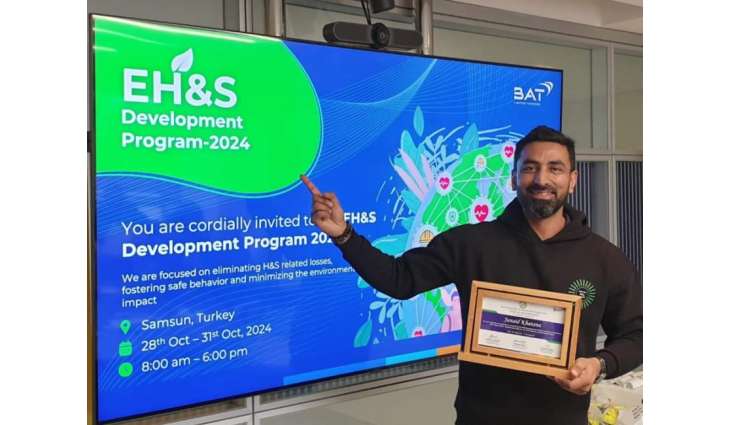
Few professionals embody this mission as comprehensively as Junaid Ahmed Khatana, whose career spans leadership positions at British American Tobacco (BAT), Coca-Cola, PepsiCo, and Nestlé. With a background in mechanical engineering and finance, Junaid has consistently driven transformation at the intersection of operational excellence and responsible leadership.
From agricultural hubs in Pakistan to complex supply chain networks in Turkey and high-risk manufacturing environments in Myanmar, his track record reflects an unwavering commitment to people-centered, globally aligned, and locally informed systems.
Extraordinary Contributions to EHS and Leadership roles
Junaid’s leadership philosophy goes beyond compliance. His work embeds ESG principles into operations, leverages AI-driven monitoring systems to anticipate risk, and ensures that sustainability is not an afterthought but a driver of innovation. He has designed resilient frameworks for safer agricultural operations worth £50 million, shaped regional EHS strategies across Asia and Europe, and helped multinational companies navigate crisis environments with continuity and care.
This excellence has been formally recognized. The Chairman’s Ring of Honor at PepsiCo in 2017 was awarded for record-breaking production paired with sustainable growth, proving that operational excellence and purpose-driven leadership can coexist. The Battlefield Bonus at BAT in 2023, won during a high-stakes period, validated the effectiveness of resilient, people-centered systems. His global deployments in India, Switzerland, Turkey, and Myanmar have also been transformative, reshaping the way he thinks about leadership, systems design, and cross-cultural impact.
Memberships and Mentorship: Shaping Innovation and Future Leaders
As an Advisory board Member at the National Incubation Center (NIC) Lahore, Pakistan’s premier government-backed startup hub, he provides strategic guidance to early-stage ventures while shaping the entrepreneurial ecosystem through mentoring and pitch evaluation. His role as a member of the IT and Infrastructure Standing Committee at the Lahore Chamber of Commerce & Industry (LCCI), one of South Asia’s most respected trade bodies, highlights peer recognition of his expertise in operational transformation and sustainability, where his input helps align industry growth with policy and environmental responsibility. Similarly, as a Senior Member of the Punjab Information Technology Board’s (PITB) Incubation Wing, he influences Pakistan’s digital ecosystem by nurturing startups and advancing technology-driven solutions that intersect with operational safety and sustainability.
Beyond entrepreneurship and policy, Junaid has also extended his influence through distinguished jury participation at leading innovation and startup platforms, including NIC Lahore, NIC Karachi, and the IPP-US New Venture Contest. In these roles, he evaluated emerging ventures, assessed business models, reviewed innovation potential, and provided expert feedback to founders working across technology, sustainability, operations, and social-impact sectors. His participation as a jury member reflects peer recognition of his professional judgment and demonstrates his broader role in shaping entrepreneurial ecosystems beyond his corporate leadership. Across these platforms, he has helped identify and guide promising ventures while encouraging inclusive participation, particularly among women and underrepresented founders, consistent with his belief that diversity strengthens resilience, innovation, and long-term institutional impact.
Publications: Thought Leadership Across Borders
Junaid’s thought leadership has shaped conversations well beyond the companies he has served. His publications and contributions to conferences demonstrate how EHS can be reimagined as a driver of transformation. In Data, AI, and Sustainability in EHS Systems, he examined the role of digital tools in shifting EHS from reactive to proactive strategies. His piece on Purpose-Driven Leadership in Complex Supply Chains distilled lessons from multinational operations where safety, compliance, and efficiency must co-exist. Similarly, in Operational Resilience in Emerging Markets, he explored the challenges of navigating regulatory and cultural differences in countries like Pakistan, Turkey, and Myanmar.
Another significant work, Sustainability as a Driver of Innovation in Regulated Industries, highlighted how compliance can evolve into a competitive advantage when paired with innovation. His contributions to Forbes, particularly in the article referencing Sheikh Raheel Rashid’s global business strategies, further amplified his insights on leadership and systems transformation. Collectively, these writings underscore his dual role as a practitioner and a thought leader, someone advancing both the practice and the philosophy of EHS globally.
The Evolving Landscape: Challenges and Opportunities
Reflecting on his journey, Junaid acknowledges that achievements such as the Chairman’s Ring of Honor and the Battlefield Bonus are not just awards—they are validations that purpose-driven leadership and resilient systems deliver real impact. These recognitions, alongside global assignments, transformed his perspective as both a leader and a person.
Looking ahead, he sees the tobacco industry and many others at a critical inflection point. Rapidly shifting regulations, consumer demand for reduced-risk products, and heightened supply chain transparency requirements are reshaping the way companies must operate. For EHS leaders, the challenge is no longer about compliance alone but about embedding safety and sustainability into the core of innovation. As he notes:
“We need to move from reactive to proactive EHS using digital tools and data. The real challenge is aligning all of that with strategy so that safety and sustainability become part of innovation, not separate from it.”
A Purpose-Driven Future
In an uncertain world where industries face unprecedented regulatory, environmental, and social pressures, Junaid Ahmed Khatana’s message remains clear: lead with purpose. Through extraordinary contributions to EHS, prestigious memberships, inclusive mentorship, and thought-provoking publications, he continues to shape safer, smarter, and more sustainable operations worldwide.
For him, real leadership is not about enforcement but about legacy the systems and values we leave behind for future generations.