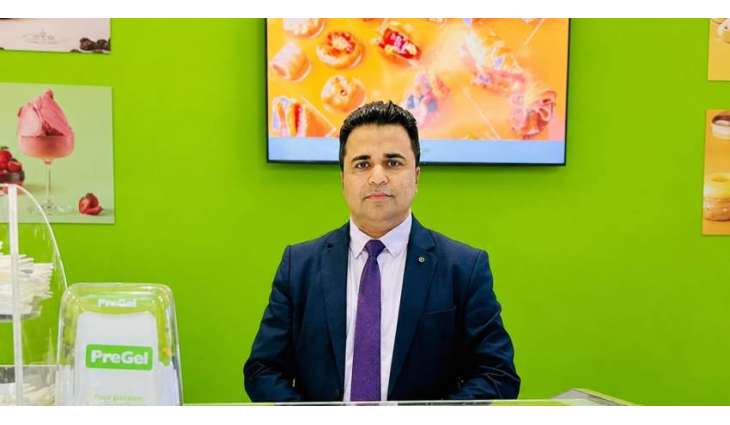
Ali Asad Cheema has built this career around refusing that drift, and the choices he has made in both the production and business development dimensions of his work reflect a settled conviction that in artisanal gelato, quality is not a feature to be marketed. It is the operating principle from which everything else follows.
LAHORE: (UrduPoint/Pakistan Point News-Jan 14th, 2025) There is a question that every premium food business eventually has to answer honestly.
Is quality central to what we are, or is it something we talk about while quietly making the compromises that growth seems to require? For many brands, the answer drifts over time toward the latter. Processes get streamlined. Ingredient specifications get loosened.
The handmade story stays on the packaging while the production reality moves in a different direction. Ali Asad Cheema has built this career around refusing that drift, and the choices he has made in both the production and business development dimensions of his work reflect a settled conviction that in artisanal gelato, quality is not a feature to be marketed. It is the operating principle from which everything else follows.
What the Industry Actually Demands
Gelato does not forgive inattention. The product is defined by characteristics that are immediately perceptible and immediately degraded by any failure in the production chain. Texture depends on precise ingredient ratios, controlled churning, and exact temperature management. Freshness cannot be extended artificially without affecting flavour. Density, which is what distinguishes genuine gelato from ice cream inflated with air, is a direct consequence of how the product is made, not how it is described. These are not qualities that can be approximated. They are either present or they are not, and an informed customer can tell the difference within a single spoonful.
Cheema came to understand this not through theory but through nearly nine years of overseeing production operations at GEMCO General Trading LLC across multiple facilities simultaneously. As Area Manager for Production, he was responsible for workforce planning, equipment commissioning, process design, quality assurance systems, corrective-action procedures, and the continuous balancing of output targets against the uncompromising standards expected by customers.
During this period, GEMCO experienced substantial operational expansion across the UAE's food-service sector. The challenge was not simply producing more. It was producing more without diluting the characteristics that made the products valuable in the first place. The systems Cheema implemented focused on standardisation, process discipline, quality-control checkpoints, and scalable production workflows that allowed growth without sacrificing consistency. The experience gave him something no classroom or management programme could replicate: a practical understanding of where quality breaks down, why businesses lose control during expansion, and what operational disciplines are required to prevent it.
Connecting Production Thinking to Commercial Growth
The position Cheema now holds at Rimini Artisanal Gelato Trading LLC, where he serves as Head of Production and Business Development, reflects a deliberate philosophy. In most food businesses these functions operate separately, with production focused on efficiency and business development focused on growth. The tension between them is treated as inevitable. Cheema's view is that it should not exist at all.
A business development strategy that outpaces production capability produces broken promises. A production operation that optimises purely for efficiency risks creating a technically consistent product that customers have little reason to prefer. Sustainable growth requires both sides of the equation to develop together.
The product-development process he has built at Rimini reflects that integration directly. New flavours move through structured experimentation, recipe testing, ingredient-ratio adjustment, staff participation, and customer tasting sessions before any commitment to large-scale production. The roasted pistachio and sea salt gelato that has become one of the company's signature offerings emerged through exactly this process, evolving through multiple rounds of refinement before reaching commercial release.
What appears from the outsideas creativity is, inreality,a highly disciplined system designed to ensure that production capability, customer demand, and quality expectations remain aligned.
From Operational Experience to Industry Methodology
The years following the COVID-19 pandemic created a new challenge within the UAE'sspecialty food sector. Demand for premium food concepts was increasing, and a growing number of entrepreneurs were entering the artisanal dessert market. Many possessed enthusiasm, investment capital, and ambitious plans. What they often lacked was a practical roadmap for turning those plans into sustainable businesses.
It was during this period that Cheema formalised many of the principles he had developed throughout his career intowhatbecameknownastheArtisanalGelatoCommercialization Framework (AGCF).
The framework was designed to answer a question that many founders struggle with: how doyou scale an artisanal business without destroying the very qualities that make it successful?
Rather than focusing exclusively on recipes, equipment, or branding, the AGCF approaches business creation as a complete commercialisation process. It integrates concept development, market positioning, production planning, ingredient sourcing, quality-control systems, operational workflow design, staff training, customer acquisition strategies, and long-term scalability planning into a single structured methodology.
The framework is built around a principle that mirrors Cheema's broader philosophy. Growth should emerge from operational readiness rather than pressure an operation into becoming ready after expansion has already begun.
Over the years, the methodology has been used to guide the launch, development, orexpansion of more than twenty artisanal food, dessert, and gelato ventures across the UAE. For many operators entering the sector, the framework provided a practical alternative to trial-and-error entrepreneurship, helping businesses establish stronger foundations before committing resources to growth.
Grounded in Pakistan's Entrepreneurial Networks
Beyond his operational leadership within the food industry, Cheema maintains active connections to several of Pakistan's most significant entrepreneurial and innovation ecosystems.
Plan9, established by the Punjab Information Technology board, has become one of Pakistan's most influential startup incubators. Through mentorship, investor access, and structured venture-development programmes, it has helped hundreds of founders navigate the challenges of early-stage business growth. Participation in this ecosystem places Cheema within a broader community of entrepreneurs and business builders focused on sustainable company creation and innovation.
Innovatrium at Beaconhouse National University provides a complementary perspective. As the university's innovation and startup-development platform, it supports emerging entrepreneurs through mentorship, resources, and structured commercialisation guidance. The programme reflects Beaconhouse National University's broader commitment to combining academic excellence with practical entrepreneurship.
The National Incubation Center Lahore extends that ecosystem even further. Supported by the Ministry of Information Technology and Telecom and operated through a consortium that includes leading technology,financial, and educational institutions, NIC Lahore has become one of Pakistan's most significant plat forms for start up development. Its work has contributed to the growth of hundreds of ventures across multiple industries while helping entrepreneurs gain access to expertise, investment opportunities, and international networks.
Cheema's involvement with these innovation communities reflects an interest that extends beyond food manufacturing itself. It connects his work in artisanal food production with broader conversations about entrepreneurship, commercialisation, and how businesses build durable competitive advantages over time.
The Longer Argument
The strategic argument Cheema has advanced throughout this career is straight forward: artisanal quality and commercial growth are not incompatible, but the sequence matters. Quality must come first, systems second, and growth third.
That philosophy shaped the production systems he helped implement atGEMCO,informedthe development of the Artisanal Gelato Commercialization Framework (AGCF), and continues to guide his work at Rimini. His plans for broader distribution, hospitality partnerships, and new product development are built on the belief that sustainable growth can only occur when operational discipline and product quality remain non-negotiable.
For Cheema, leadershipintheartisanalfoodindustryisnotmeasuredbyhowquicklyabusiness expands, but by its ability to grow without compromising the standards that earned customer trust in the first place.