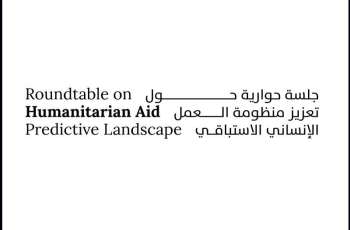
ABU DHABI, (Pakistan Point News - 15th Jun, 2026) Under the patronage of H.H. Sheikh Theyab bin Mohamed bin Zayed Al Nahyan, Deputy Chairman of the Presidential Court for Development and Fallen Heroes Affairs, the Office of Development Affairs at the Presidential Court has announced that it will hold a dialogue on strengthening the system of anticipatory humanitarian action. The session will be held on Tuesday at the Zayed National Museum in Abu Dhabi, with the participation of a distinguished group of international experts in humanitarian affairs and artificial intelligence.
The session forms part of a landmark initiative aimed at exploring ways to bridge the gap between the ability to predict humanitarian crises and the capacity for early action — enabling more effective and timely responses. It will do so by examining the role of predictive analytics and artificial intelligence in enhancing the readiness of the global humanitarian system.
Discussions will focus on how predictive technologies and AI can support anticipatory humanitarian action and improve the ability of relevant actors to move from risk forecasting to timely, practical intervention.
The session is being convened in conjunction with a feasibility study being conducted by the Office of Development Affairs on developing and strengthening anticipatory humanitarian action capabilities. It is designed to deliver four key outcomes: establishing a shared understanding of the current landscape and priority gaps in forecasting and early warning capacities; identifying the UAE’s potential role in this field; providing strategic inputs to support the feasibility study and inform next steps; and laying the groundwork for continued collaboration and knowledge exchange among practitioners and partners across the humanitarian sector.
Speaking on the occasion, Dr. Tareq Al Ameri, Director of the Office of Development Affairs, noted that the global humanitarian system is facing mounting pressure as a result of budget constraints, declining contributions from donors, and a widening gap between the scale of needs and available resources.
At the same time, he observed that rapid advances in technology — particularly in artificial intelligence — have introduced powerful new tools for predicting natural disasters and humanitarian risks.
Dr. Al Ameri affirmed that the dialogue session reflects the UAE’s broader efforts to identify existing gaps in global capacity to anticipate humanitarian crises, develop forward-looking solutions to strengthen humanitarian preparedness, and consolidate the country’s role in providing humanitarian support and leading global thinking on the future of this vital sector.
He further explained that the session aims to foster in-depth discussion on the strategic, technical, operational, and governance dimensions associated with developing humanitarian crisis forecasting capabilities, and to help determine the practical value of such capabilities for the international humanitarian system.
Dr. Al Ameri added that the session is expected to contribute to tangible progress within the humanitarian aid ecosystem — through supporting more effective resource allocation, reducing financial costs, raising levels of preparedness, guiding humanitarian interventions with greater precision, and strengthening partnerships across humanitarian, technological, and donor communities.
The session is expected to produce a raft of outputs, including a summary of key insights and recommendations to inform the feasibility study, as well as a white paper presenting the strategic case, vision, and potential impact of developing forecasting capabilities in humanitarian action — drawing on discussions held among the session’s assembled experts and participants.
The organisation of this session reflects the UAE’s longstanding development and humanitarian legacy, which dates to the founding of the Union under the late Sheikh Zayed bin Sultan Al Nahyan, who established a humanitarian ethos grounded in generosity, solidarity, and service to humanity.
The UAE, under the leadership of President His Highness Sheikh Mohamed bin Zayed Al Nahyan, continues the Founder’s legacy through quality initiatives that combine humanitarian values, global collaborations, and modern technology in a way that enables early effective interventions in crises and disasters.