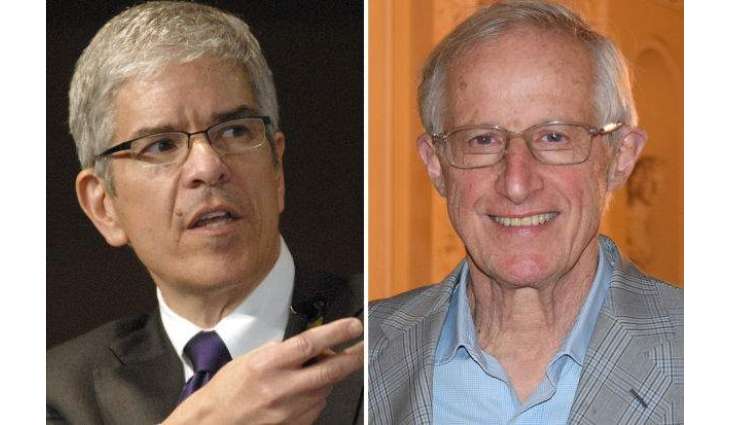
The Sveriges Riksbank Prize in Economic Sciences in Memory of Alfred Nobel 2018 has been awarded to US economists William D. Nordhaus for integrating climate change into long-run macroeconomic analysis and Paul M. Romer for integrating technological innovations into long-run macroeconomic analysis.
MOSCOW (Pakistan Point News / Sputnik - 08th October, 2018) The Sveriges Riksbank Prize in Economic Sciences in Memory of Alfred Nobel 2018 has been awarded to US economists William D. Nordhaus for integrating climate change into long-run macroeconomic analysis and Paul M. Romer for integrating technological innovations into long-run macroeconomic analysis.
Nordhaus was born on May 31, 1941 in Albuquerque, the US state of New Mexico.
In 1963, he received bachelor's and master's degrees from Yale University and in 1967 he earned a Ph.D. in Economics from the Massachusetts Institute of Technology in Cambridge.
In 1967-1970, he was a senior lecturer in economics at Yale University.
In 1970-1973, Nordhaus was an associate professor of economics at Yale University.
Since 1973, he is a professor at Yale University.
In 1977-1979, he was a member of the US Council of Economic Advisors.
In 1986-1988, he served as the Provost of Yale University.
Since 2001, he holds the highest academic rank at Yale University - Sterling Professor.
In 2013-2015, he was a director and served as chair of the Boston Federal Reserve Bank.
From 2015 to 2016, he served as President of the American Economic Association.
Nordhaus is emeritus professor at Tianjin University (2006), Xian University (2008) and others and associate professor at the University of Copenhagen (2008).
He is a member of the US National academy of Sciences, he occupied posts at a number of committees, including the Committee on the Implications for Science and Society of Abrupt Climate Change.
Since the 1970s, Nordhaus has developed economic approaches to global warming, including the construction of integrated economic and scientific models (the DICE and RICE models) to determine the efficient path for coping with climate change.
In the mid-1990s, Nordhaus became the first person to create an integrated assessment model that describes the global interplay between the economy and the climate.
He is the author of many books, including the classic textbook Economics (joint with Paul Samuelson), The Efficient Use of Energy Resources, Managing the Global Commons, Warming the World and others.
In 2004, Nordhaus was awarded the prize of "Distinguished Fellow" by the American Economic Association.
Romer was born on November 7, 1955 in the city of Denver in the US state of Colorado.
In 1977 he graduated from the University of Chicago, where he received a bachelor's degree in mathematics.
In 1983, he received a Ph.D. in economics.
In 1987, he became a research associate at the National Bureau of Economic Research.
In 1988, he worked at the Alfred Sloan Foundation.
In 1989, Romer worked at the Center for Advanced Study in the Behavioral Sciences, while in 1990, at the Econometric Society, an international society for the advancement of economic theory in its relation to statistics and mathematics.
In 1996, he became executive council member of the American Economics Association.
He taught at Stanford Graduate school of Business, University of California at Berkeley, University of Chicago and the University of Rochester.
Romer was formerly a senior fellow at the Hoover Institution.
In 2010, he became a fellow of the Center for Global Development in Washington.
Since fall 2011, he has been working as a professor of economics at the NYU Stern School of business in New York.
On July 18, 2016, World Bank Group President Jim Yong Kim appointed Romer as World Bank Chief Economist. He took office in September 2016.
On January 24, 2018, he decided to resign due to a conflict with employees.
Romer is the founder of Romer model, which shows steady economic growth based on technological progress, which is achieved by long-run growth in output per worker.
Romer is an author of many scientific papers, a member of American Academy of Arts and Science, honorary professor at East China Normal University (2013) and winner of the Recktenwald Prize in Economics (2002).
In 1997, according to Time magazine, Romer was named one of the 25 most influential people in the United States.