DUBAI, (Pakistan Point News - 15th Jul, 2026) Dubai Future Foundation (DFF) has released the fifth edition of its annual flagship foresight report, “Future Opportunities: The Global 50”, analysing progress across 50 future opportunities identified in previous editions and providing governments, organisations, and individuals with a strategic framework to better understand their role in turning future possibilities into reality.
Each opportunity raises fundamental questions for decision-makers: How can your organisation benefit from this opportunity? What role should it play in shaping it? For individuals, the report asks: Where should you direct your efforts and investments, and what skills will you need to navigate the challenges ahead?
The report explores pathways toward a future defined by sustainable growth, prosperity, and well-being. It focuses on the critical shift from ideas to implementation and examines the investment and financing needed to strengthen collaboration, and build the systems required to unlock the full potential of emerging innovations.
Dubai Future Foundation developed the report through research including roundtable engagement with more than 180 experts from the UAE and around the world exploring five long-term assumptions: Climate Change Will Persist, Inequalities Will Continue, Lives Will Be Longer and Healthier, Global Interdependencies Will Remain, and Technology Will Continue to Advance.
Mohammad Al Gergawi, Vice Chairman of the board of Trustees and Managing Director of Dubai Future Foundation and Chairman of the Museum of the Future, said the future is shaped by those who see challenges not as obstacles, but as the starting point for progress.
He said, “Every future opportunity is an invitation to think differently, act with courage, and believe in the possibility of a better tomorrow.”
He added, “Since its founding, the UAE, guided by the vision of its leadership, has built an inspiring global model driven by an ambitious mindset that sees challenges as opportunities for growth and progress. The most impactful decisions about the future are often made during the most challenging circumstances and beyond conventional expectations.”
He continued: “The UAE’s experience has shown that transformative change begins with bold decisions; decisions that do not simply respond to the present, but redefine what is possible for the future. This is the mindset our institutions, cities, and societies need today.”
The report covers 50 future opportunities across critical sectors, asking questions that range from how the next generation of robots could transform society to whether energy could one day be generated and stored in space. It examines whether clothing could support human health, safe drinking water could become universally accessible, antibiotics could be replaced by more targeted therapies, and electricity could be transmitted with virtually no loss.
Among the opportunities highlighted is the next generation of robotics. Affordable, globally robotic platforms deployable at scale could provide practical solutions to challenges once considered difficult to address and accelerate progress toward the Sustainable Development Goals.
The AI robotics market is expected to grow by 280 percent by 2030, underscoring the accelerating convergence of intelligent systems and physical technologies
The report also examines the potential of making scientific and academic publications accessible through open, centralised platforms. Such systems could accelerate innovation, strengthen interdisciplinary collaboration, expand global knowledge exchange and enable more people to participate in the creation and application of scientific knowledge.
The report examines floating solar arrays in space, operated by advanced machine intelligence capable of identifying optimal locations and orbits. Such systems could generate renewable energy around the clock and transmit it reliably to Earth.
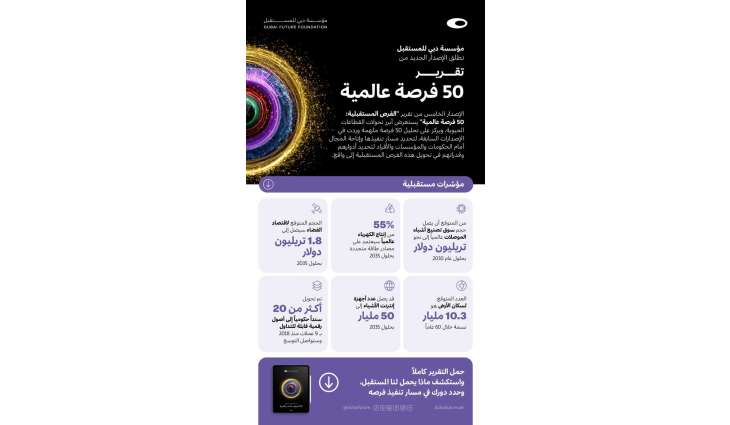
This opportunity comes as clean energy sources are projected to account for 55 percent of global electricity generation by 2035.
Advances in superconducting materials could meanwhile enable electricity to be transmitted to individuals and industries with virtually no energy loss, creating more efficient, flexible and resilient power networks.
Advances in nanobiomaterials and synthetic materials could enable the development of smart fabrics capable of providing the human body with minimum daily vitamin requirements, supporting health and addressing nutrient deficiencies.
The report also highlights the largely unexplored potential of marine biodiversity. The world's oceans could unlock new opportunities in marine biotechnology and pharmacology, supporting innovation in the pharmaceutical and food industries while reinforcing the importance of ecosystem protection. This is particularly significant given that 75 percent of new infectious diseases emerge in areas that have experienced severe biodiversity disruption.
Emerging carbon-based nanomaterials could also transform access to clean water by enabling more effective pollutant filtration, while bacteriophages present promising alternatives to traditional antibiotics through highly targeted treatments. The opportunity is particularly urgent as 2.1 billion people worldwide still lack access to safe drinking water.
Bacteriophages, including genetically engineered variants, could meanwhile offer a targeted alternative to conventional antibiotics by directly attacking disease-causing bacteria.
The future of mobility could be reshaped by breakthrough technologies in wheels and vehicle systems. The report explores innovations ranging from magnetic levitation and drone-inspired technologies to advanced alternatives to rubber tyres that could reduce energy consumption and emissions.
Rapid advances in quantum physics could also revolutionise communications, encryption and computing, creating digital environments that are increasingly integrated into everyday life.
Advances in satellite networks and artificial intelligence could dramatically expand global access to high-efficiency internet connectivity while strengthening the resilience of global communication systems. These systems could also support the rapid growth of the Internet of Things and reduce network disruption by intelligently switching between terrestrial cellular and satellite networks.
Space research could also inspire a new generation of self-sufficient homes capable of providing essential living requirements while reducing pressure on the planet's resources.
These opportunities are emerging alongside the rapid growth of the space economy, which is projected to reach US$1.8 trillion by 2035.
The report explores a future in which data is increasingly stored and processed on devices closer to its source rather than continuously transmitted to centralised data centres. The expansion of edge computing could accelerate data processing, reduce latency and improve the performance of artificial intelligence, machine learning, augmented reality and connected systems. The number of Internet of Things devices worldwide could reach 50 billion by 2035, while the global semiconductor market is expected to reach US$1 trillion by 2030.
Machines could also become capable of detecting and repairing faults without human intervention. By combining predictive maintenance, smart materials and advanced sensors, self-repairing systems could enable continuous manufacturing, extend the lifespan of consumer products and robots, and improve long-term sustainability.
Personalised bioprinting could fundamentally transform organ transplantation by creating organs from a patient's own cells, potentially improving biological compatibility and survival rates.
Contactless haptic technologies could meanwhile redefine how humans interact with digital environments by allowing people to experience a sense of touch without wearable devices. The technology could transform gaming, extended reality, healthcare and everyday digital interactions.
The report also explores the growing strategic value of collective intelligence: the ability of people to think, innovate and collaborate at scale. It asks what might happen if this capability became one of the most valuable resources available to nations.
Looking further ahead, the report examines whether intellectual property rights could be fractionalised and restructured as tradeable assets. More than 20 government bonds across eight currencies have already been tokenised since 2018, pointing to broader shifts in how rights, ownership and assets may be structured in the future.
The report also considers these opportunities against wider demographic shifts. The global population is projected to reach 10.3 billion in 60 years, adding new urgency to the search for scalable solutions across energy, health, food, water, infrastructure and technology.
The “Future Opportunities: The Global 50” report is available in both Arabic and English. Download the report: https://www.dubaifuture.ae/the-global-50/