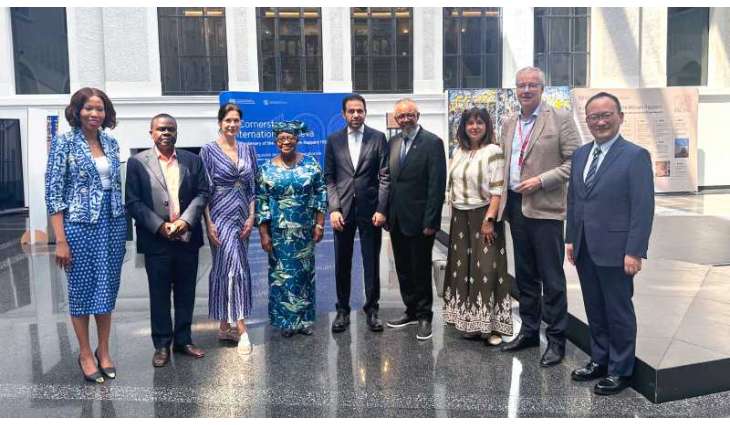
GENEVA, (Pakistan Point News - 09th Jul, 2026) The Muslim Council of Elders’ participation in the Global Dialogue on Artificial Intelligence Governance in Geneva featured a series of meetings and discussions with international, UN, and religious leaders.
These engagements focused on the importance of strengthening international cooperation, promoting shared human values, and supporting efforts to build a more peaceful and united world amid rapidly evolving global challenges.
The Council’s participation reflects the intellectual and humanitarian vision championed by His Eminence Professor Dr. Ahmed Al-Tayeb, Grand Imam of Al-Azhar and Chairman of the Muslim Council of Elders, to advance the values of dialogue, peace, and human fraternity worldwide.
Judge Mohamed Abdelsalam, General Advisor to the Muslim Council of Elders, met with Dr. Ngozi Okonjo-Iweala, Director-General of the World Trade Organization and a member of the judging committee of the 2025 Zayed Award for Human Fraternity; Dr. Tedros Adhanom Ghebreyesus, Director-General of the World Health Organization; Anda Filip, Secretary General of the Inter-Parliamentary Union; a number of ambassadors and permanent representatives to the United Nations and international organisations in Geneva; along with Rev. Dr. Jerry Pillay, General Secretary of the World Council of Churches.
During these meetings, Judge Mohamed Abdelsalam highlighted the mission of the Muslim Council of Elders and its efforts to promote dialogue among religions and cultures and advance the values of human fraternity, coexistence, and peace.
He reaffirmed the Council’s commitment to building effective international partnerships that contribute to addressing humanitarian challenges and translating shared values into practical initiatives that serve humanity and safeguard human dignity.
He also noted that the Zayed Award for Human Fraternity, launched in Abu Dhabi, has become a global platform celebrating inspiring humanitarian efforts and promoting the values of fraternity, coexistence, and mutual understanding among peoples.
International leaders praised the award’s growing global stature as an independent recognition of humanitarian initiatives and efforts that advance shared human values. They emphasised that the award’s international prominence reflects the increasing need for such initiatives at a time when the world faces multiple conflicts and crises, helping to build a more peaceful and humane future for humanity.
Judge Mohamed Abdelsalam also discussed with Dr. Tedros Adhanom Ghebreyesus the importance of strengthening the role of interfaith and intercultural dialogue in supporting peacebuilding efforts. He stressed that peace is both a humanitarian and moral imperative that enables health and humanitarian institutions to fulfill their mission of protecting lives and preserving human dignity, particularly amid wars and conflicts whose consequences are borne most heavily by innocent civilians and vulnerable communities.
In this context, the Director-General of the World Health Organization praised the leading role played by the United Arab Emirates in promoting the values of tolerance and human fraternity and supporting WHO efforts to address global health challenges and respond to humanitarian crises.
Judge Mohamed Abdelsalam also met with Rev. Dr. Jerry Pillay, General Secretary of the World Council of Churches, to discuss prospects for cooperation between the Muslim Council of Elders and the World Council of Churches.
The discussions focused on strengthening joint efforts to combat hate speech and extremism and building bridges of trust and understanding among followers of different religions and cultures. Rev. Dr. Pillay emphasised the importance of the UAE model in promoting the values of human fraternity and interreligious and intercultural dialogue, describing it as an inspiring example of advancing coexistence and peace.
The meeting also highlighted the urgent need for religious leaders and international institutions to join forces in strengthening human solidarity in the face of global crises and placing human beings and their dignity at the center of international priorities. Such an approach would help ensure that scientific and technological progress—particularly in the field of artificial intelligence—remains dedicated to serving humanity and advancing the common good.
These meetings form part of the Muslim Council of Elders’ ongoing efforts to expand its international engagement, strengthen partnerships with UN, religious, and intellectual institutions, support pathways of interreligious and intercultural dialogue, and promote the values of human fraternity, peace, and coexistence.