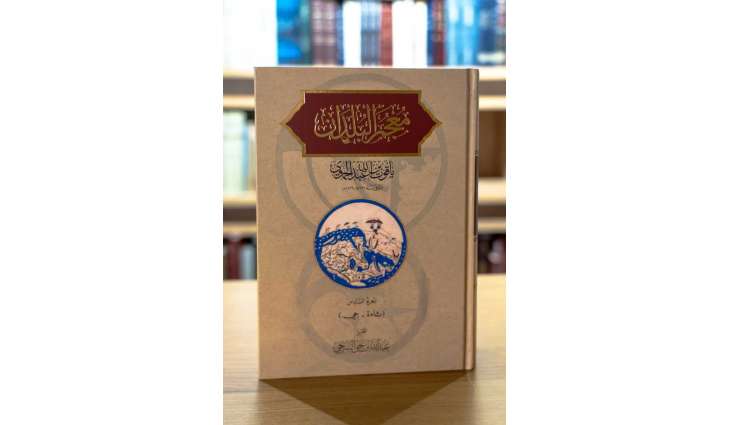
ABU DHABI, (Pakistan Point News - 09th Jul, 2026) The Department of Culture and Tourism - Abu Dhabi (DCT Abu Dhabi) has announced the publication of a landmark scholarly edition of Mu'jam al-Buldan (Dictionary of Countries), one of the most important and comprehensive geographical dictionaries in Arab-Islamic heritage.
Originally authored by Yaqut al-Hamawi (d. 1229 CE) in the 13th century, the new six-volume edition has been rigorously edited and verified, updating centuries-old geographical entries to reflect their contemporary status and bridging historical Arab-Islamic scholarship with the needs of modern researchers. It represents a defining contribution to the safeguarding and dissemination of its intellectual legacy.
Mu'jam al-Buldan stands as a key record of Arab-Islamic civilisation, spanning 15,038 geographical entries covering the Islamic world from the far reaches of Al-Andalus to the borders of China. Compiled before the Mongol fragmentation of the Islamic world and before the fall of Al-Andalus, the encyclopedia captured the breadth and richness of the Arab-Islamic world.
Beyond its geographical scope, the work serves as a multi-disciplinary encyclopaedic reference. It encompasses literary, scientific, historical and social knowledge, making it an indispensable resource for researchers across a wide range of academic fields.
Under the scholarly editorship of Abdallah Al Sareehi, entries have been updated to reflect the modern status of every place mentioned - identifying locations that still exist, those that have disappeared, changes in place Names and precise contemporary geographical positions.
This critical process ensures the work bridges centuries of scholarship with contemporary relevance, making it as valuable to today's researchers and academics as it was to scholars of the medieval Islamic world.
Abdallah Al Sareehi, Editor of Mu'jam al-Buldan and Researcher within DCT Abu Dhabi, said, "Mu'jam al-Buldan has been a foundational reference for researchers in Arab-Islamic heritage for centuries. Yaqut al-Hamawi documented the literary, scientific, historical, social and geographical knowledge of the Islamic world with remarkable detail and precision, and the work has remained relevant across disciplines, from history and geography to literature and the social sciences.
What this edition adds is critical context for the modern reader. Every entry has been reviewed to identify whether a place still exists, whether its name has changed and where it sits on a contemporary map. Without that, a significant portion of the work becomes inaccessible to today's researchers.”
He added, "Our aim was to ensure that nothing is lost in the distance between the 13th century and now. This encyclopedic dictionary is a record of a civilisation, and it deserves to be read, studied and understood by the generations that have inherited its legacy.”
A flagship publication by DCT Abu Dhabi, Mu'jam al-Buldan forms part of the Culture Sector's broader publications catalogue, a growing body of work dedicated to protecting, preserving and promoting Arab-Islamic heritage. Through landmark publications such as this, DCT Abu Dhabi ensures that the intellectual contributions of Arab-Islamic scholars are not lost to time, but celebrated and made accessible to academic and cultural communities.
The publication of Mu'jam al-Buldan is the latest chapter in DCT Abu Dhabi's sustained commitment to knowledge, heritage and accessibility. The Golden Ink exhibition and the Abu Dhabi International Conference on Manuscripts brought the artistry and scholarship of Arabic manuscripts to audiences worldwide.
The collaboration with French author Gilbert Sinoué on L'ÂGE D'OR DE LA CIVILISATION ARABE (The Golden Age of Arab Civilisation) brought the story of Arab-Islamic civilisation to global readers in both French and Arabic.
Each initiative has deepened Abu Dhabi's relationship with the written word and the stories it carries. Mu'jam al-Buldan stands at the heart of this story, reflecting what happens when a city commits to preserving, studying and passing its heritage forward.