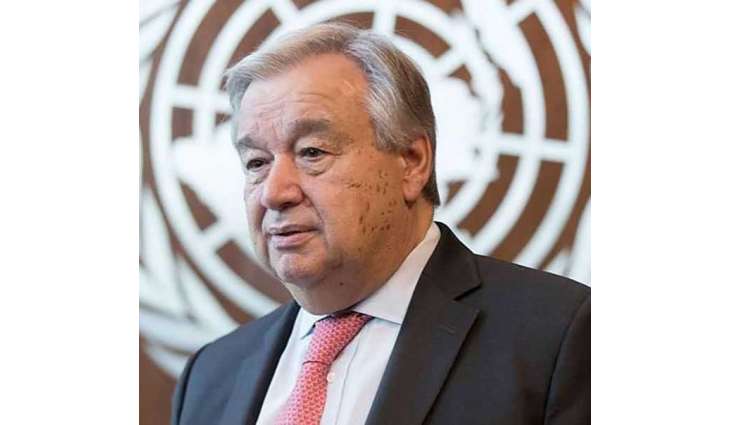
NEW YORK, (Pakistan Point News - 06th Jul, 2026) UN Secretary-General António Guterres has called for renewed international commitment to the “Responsibility to Protect” principle, warning that early signs of atrocity crimes are too often ignored and that global responses frequently come “too little, too late.”
In remarks delivered to the General Assembly by his Chef de Cabinet, Courtenay Rattray, Guterres said the principle remains “more vital than ever” as conflicts grow more prolonged, complex and interconnected.
The Secretary-General recalled that 21 years ago, world leaders pledged to protect populations from genocide, war crimes, ethnic cleansing and crimes against humanity. He said the commitment affirmed that each state has the Primary responsibility to protect its own people, while the international community promised to take collective, timely and decisive action under the UN Charter when national authorities fail to do so.
“Atrocity crimes can happen anywhere,” Guterres said. “But their effects on the world, and on our humanity, are shared.”
The remarks accompanied the General Assembly’s discussion of the latest UN report on the Responsibility to Protect, the 18th since the commitment was adopted. Guterres said the report reviews two decades of progress and highlights the importance of cooperation among affected communities, civil society, regional organisations and the United Nations.
He pointed to examples of leadership in prevention, including preventive diplomacy, dialogue, early warning systems, independent justice institutions, support for media and civil society, and efforts to embed atrocity prevention across UN humanitarian, political, peacebuilding and peace operations work.
But Guterres warned that the world now faces a more dangerous environment. He said there were more than 120 conflicts in 2025, alongside widespread violations of international law and a growing sense of impunity.
He also cautioned that technology is intensifying risks, citing increasingly sophisticated and autonomous weapons, including drones, as well as the rapid spread of online hate speech, misinformation and disinformation.
“We need to be proactive and vigilant, and act before warning signs become mass graves,” he said.
The Secretary-General said the report calls on member states to strengthen national prevention and protection programmes, designate focal points, establish domestic institutional arrangements and build partnerships with civil society.
At the regional and multilateral levels, he said atrocity prevention should be integrated across peacemaking, conflict prevention and humanitarian tools, including mediation, preventive diplomacy, security, technology, human rights and accountability frameworks.
Guterres stressed that the responsibility to protect does not end when violence stops. Preventing recurrence, he said, requires truth, justice, accountability, reparations, institutional reform and the meaningful participation of survivors.
He also emphasised the need for women’s voices to be heard and for a gender perspective to be included throughout these processes.
The Secretary-General encouraged member states to join and implement relevant international legal instruments, including the Convention on the Prevention and Punishment of the Crime of Genocide.
“The Responsibility to Protect goes to the heart of our mission at the United Nations,” Guterres said. “It provides a practical pathway to prevention and peace, rooted in our shared humanity and the dignity of every person.”
He urged member states to uphold the promise made by world leaders in 2005 and ensure that atrocity prevention and the protection of populations become “a permanent and universal practice everywhere.”