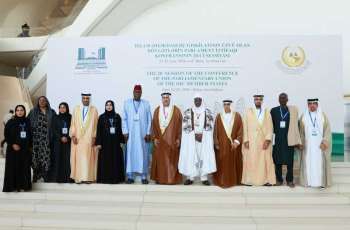
MANAMA, (Pakistan Point News - 25th Jun, 2026) The Kingdom of Bahrain hosted the Ministerial Meeting between the Gulf Cooperation Council (GCC) and the United States today, co-chaired by US Secretary of State Marco Rubio and Dr. Abdullatif bin Rashid Al Zayani, Bahrain's Minister of Foreign Affairs and current Chairman of the GCC Ministerial Council, with the participation of GCC foreign ministers and GCC Secretary-General Jasem Mohamed Albudaiwi.
Secretary Rubio reaffirmed the United States' enduring commitment to the security of the GCC states, while the GCC foreign ministers reiterated their strong commitment to the strategic partnership between the GCC and the United States.
The ministers welcomed the signing of the memorandum of understanding (MoU) between the United States and Iran on 17th June and recognised the mediation efforts of Pakistan and Qatar. They stressed the importance of maintaining momentum and unity in negotiations aimed at achieving a permanent end to hostilities and preventing Iran from developing or acquiring a nuclear weapon.
The ministers said lasting regional peace and security requires addressing all Iranian threats, including its ballistic missiles, drones and support for proxy groups in the region.
They also stressed the importance of reopening the Strait of Hormuz, noting that free, unconditional and unrestricted navigation, including the right of transit passage under international law, remains essential to regional and global security.
The ministers rejected any tolls, fees or attempts to assert control over the Strait and welcomed the announcement by the Sultanate of Oman and the International Maritime Organisation on launching an evacuation plan for more than 11,000 seafarers stranded in the region.
They emphasised that any trade and investment with Iran would remain conditional and reversible, depending on Iran's compliance with the MoU and any final agreement, the cessation of its destabilising activities and the creation of conditions conducive to economic engagement.
The ministers expressed support for the Syrian people in building a stable, secure, inclusive and sovereign state fully integrated into its regional environment, reaffirming their commitment to Syria's sovereignty, unity and territorial integrity.
They agreed to continue working with the Syrian government and support efforts to address key challenges, including counter-terrorism, restoring essential services, improving the investment climate and enabling the voluntary return of refugees and internally displaced persons.
The ministers reaffirmed their commitment to Lebanon's sovereignty, security, stability and territorial integrity, welcoming the ongoing US-facilitated bilateral negotiations between Israel and Lebanon aimed at creating conditions for a lasting peace and security agreement.
They welcomed a practical approach to restoring security, extending Lebanese state authority and demarcating permanent borders, stressing that full Lebanese sovereignty cannot be achieved while non-state armed groups retain military capabilities outside state control. They called for the complete disarmament of all such groups and reaffirmed the importance of supporting the Lebanese Armed Forces.
The ministers reaffirmed their support for US President Donald Trump's comprehensive plan to end the conflict in Gaza, as endorsed by United Nations Security Council Resolution 2803.
Secretary Rubio welcomed the GCC states' historic participation in the board of Peace and thanked them for their commitments to advancing stabilisation, recovery and reconstruction efforts in Gaza.
The ministers stressed the importance of disarming all non-state armed groups to enable Gaza's reconstruction and transferring responsibility to an independent Palestinian technocratic civilian committee.
They also welcomed President Trump's statement opposing the annexation of the West Bank, saying progress in Gaza's redevelopment and reforms within the Palestinian Authority would help create conditions for a credible pathway towards Palestinian self-determination and statehood. They reaffirmed that no one would be forced to leave Gaza and that those wishing to leave would be free to return.
The ministers condemned attacks by Iran-backed groups in Iraq against GCC states, including drone attacks targeting civilian facilities, critical infrastructure and energy security. They reiterated support for the new Iraqi government's efforts to ensure weapons remain under state control and prevent non-state armed groups from using Iraqi territory to threaten neighbouring countries.
They also reaffirmed respect for Kuwait's sovereignty and territorial integrity in accordance with international law and relevant United Nations Security Council resolutions, including Resolution 833, stressing Kuwait's sovereignty over its territorial waters and calling on Iraq to fulfil its bilateral and international obligations.
The ministers further stressed the importance of the Iraqi government taking all necessary measures to ensure the safety and security of diplomatic missions in Iraq and protect them from threats or attacks, in line with Iraq's international obligations.