Singapore, July (پاکستان پوائنٹ نیوز 01 يوليو 2026ء) The agreement aims to enhance international cooperation and facilitate the exchange of expertise and knowledge, contributing to greater operational efficiency and reinforcing the Kingdom's position as a leading global aviation hub.
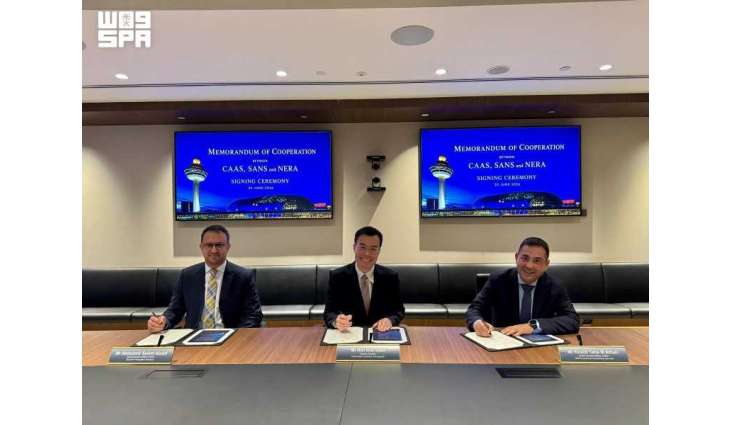
The MoU was signed during an official visit to Singapore by SANS CEO Eng. Abdulaziz bin Salem Al-Zaid, NERA CEO Eng. Khaled Attia, and CAAS Director-General Han Kok Juan.
The agreement establishes a strategic framework for knowledge exchange and collaboration in developing and implementing joint initiatives across air navigation services, sustainability, innovation, and emerging aviation concepts. It is expected to support the efficient flow of air traffic between the middle East and Asia while strengthening cooperation in the safe and effective integration of advanced air mobility technologies and the development of unmanned aircraft traffic management.
The MoU comes amid anticipated growth in global passenger and air cargo traffic. It focuses on enhancing coordination and integration between the air navigation systems of the parties, facilitating regional and international connectivity through one of the world's key air corridors.
The agreement also supports the objectives of the Kingdom's Aviation Strategy and Saudi Vision 2030, which seek to strengthen the Kingdom's position as a global aviation hub, improve the efficiency of the air transport system, expand international partnerships, and promote innovation and knowledge exchange to support the sector's growth and sustainability.
The MoU provides a practical framework for cooperation in several strategic areas, including the development of regional air traffic management in line with international best practices, the exploration and development of interoperable navigation technologies and solutions, the joint design and development of systems, system maintenance solutions, and the establishment of innovation laboratories.
It also covers the exchange of best practices in air traffic management systems, organizational transformation, and human capital development to enhance workforce efficiency and reliability, as well as cooperation in aviation sustainability through the exchange of knowledge, best practices, and initiatives aimed at improving operational performance.