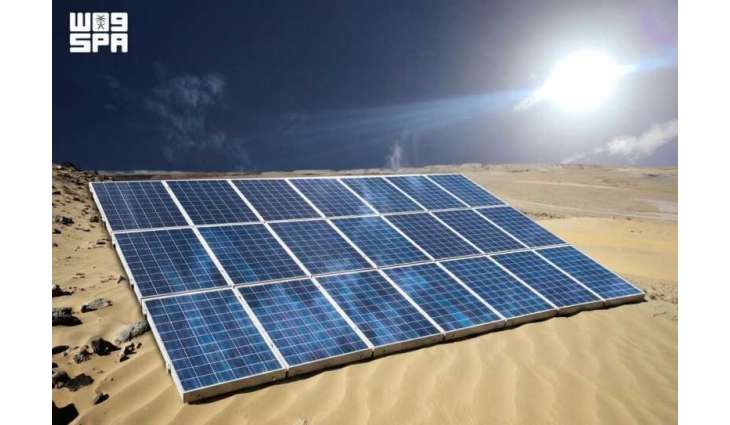
Jeddah, June (پاکستان پوائنٹ نیوز 11 يونيو 2026ء) Dust accumulation remains one of the most significant challenges facing solar energy systems, particularly in hot, arid regions with limited rainfall, where solar panels require regular cleaning that consumes substantial amounts of water and increases operating costs. The innovation was developed to address this challenge.
KAUST researchers tested the coating outdoors on the university's campus for six months. The coated solar panels showed only a slight decline in performance, while uncoated panels exposed to the same conditions experienced a significant drop in efficiency. At the same time, the coated surface successfully captured moisture from the air at night, which was subsequently used to irrigate plants in a controlled field experiment.
The coating consists of a transparent nanostructured material made from a special type of silicon that is safe for use in food-related applications.
It combines three functions in a single layer: allowing sunlight to pass through, repelling water and dust, and lowering the surface temperature to slightly below the surrounding air temperature at night. This temperature drop causes moisture in the air to condense into water droplets that slide off the surface, carrying away accumulated dust.
In addition to its self-cleaning capability, the technology enables surfaces to capture moisture from the air.
Field tests showed that coated panels produced more than twice the amount of condensed water as uncoated surfaces under the same conditions. Although the volumes collected were modest, they were sufficient to support small-scale irrigation within the study, highlighting the technology's promising potential for use in local agricultural environments.
Professor of Material Science and Engineering at KAUST and the lead author of the study Qiaoqiang Gan said the research team focused on a practical challenge faced by all solar energy systems: maintaining efficiency in environments where dust and heat are difficult to avoid.
“By using naturally occurring temperature changes between day and night, we can enable passive cleaning without additional water or energy input,” he said.
The coating is produced through a simple thermal process and can be applied to standard glass surfaces, supporting its potential for scalability in future applications.
The research team is currently assessing the coating’s durability and performance over longer time periods and under a range of environmental conditions.